
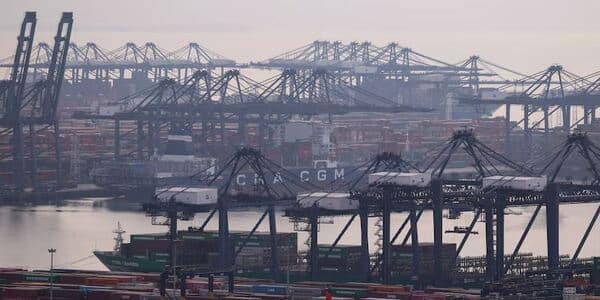


China’s Exports Outperform Expectations as Markets Beyond the U.S. Strengthen
China’s export sector showed renewed strength in November, exceeding market forecasts as manufacturers deepened commercial ties with regions outside the United States. The shift reflects China’s long-term strategic response to elevated U.S. tariffs and ongoing geopolitical uncertainty.
According to customs data released Monday, exports rose 5.9% year-on-year, reversing a 1.1% decline in October and outperforming a Reuters poll predicting 3.8% growth. The gains were led by robust shipments to the European Union, Australia, and dynamic Southeast Asian markets.
Imports edged up 1.9%, below economists’ expectations but still marking a slight improvement from October’s 1.0% rise.
Why China’s Export Growth Is Rebounding
Economists say the rebound highlights the effectiveness of China’s trade diversification strategy. With U.S. tariffs averaging 47.5%—well above levels that typically erode profit margins—exporters have prioritized growth in alternative markets.
Zichun Huang, China economist at Capital Economics, noted that while recent U.S.–China tariff concessions offered limited benefits, global demand continues to enhance China’s competitiveness. She added that trade rerouting remains an increasingly important tool for offsetting U.S. tariff pressure.
Exports to the United States, however, fell sharply—down 29% year-on-year. This decline came despite an agreement announced in early November to scale back some tariffs following a meeting between President Donald Trump and Chinese President Xi Jinping.
Key Export Markets Driving Growth
November’s data revealed notable growth across several major regions:
- European Union: Shipments surged 14.8% year-on-year
- Australia: Exports climbed 35.8%
- Southeast Asia: Demand increased 8.2%
This broad-based expansion pushed China’s monthly trade surplus to $111.68 billion, the largest since June and well above economists’ projections.
For the first time, China’s trade surplus for the January–November period surpassed $1 trillion.
Electronic machinery and semiconductors were standout contributors, buoyed by global shortages and strong demand from Chinese firms expanding abroad.
Domestic Policy Focus Shifts Toward Internal Demand
China’s yuan strengthened on Monday, reflecting improved investor confidence ahead of several key political and economic meetings.
The Communist Party’s Politburo pledged new measures to expand domestic demand—a strategic shift aimed at reducing economic reliance on exports. Analysts expect further policy direction at the upcoming Central Economic Work Conference, where officials will outline economic goals for the new year.
Economists estimate that reduced access to the U.S. market has trimmed China’s overall export growth by roughly 2 percentage points, equal to about 0.3% of GDP.
Soft Spots: Factory Activity and Domestic Demand
Despite stronger exports, broader factory activity remained under pressure, contracting for an eighth consecutive month. While manufacturers reported improved export orders, they still remained in contraction territory, underscoring persistent uncertainty.
Domestic demand also showed signs of strain. A prolonged property downturn continues to weigh heavily on consumption and investment:
- Unwrought copper imports declined, reflecting weaker construction and industrial activity.
- Rare earth exports jumped 26.5% month-on-month, following commitments by Xi and Trump to accelerate shipments.
- Soybean imports are on track to hit a record high as China increases purchases from both the U.S. and Latin America.
According to Lynn Song, ING’s chief economist for Greater China, building a sustainable domestic-demand-driven growth model will take time but remains essential for China’s next economic phase.
Outlook: Resilient Export Sector Faces Crosswinds
China’s export apparatus remains resilient, supported by rising global market share and strategic diversification. Yet, challenges persist—particularly the reliance on markets increasingly shaped by geopolitical tension and the need for stronger domestic demand.
As policymakers prepare for year-end economic planning, China’s ability to balance global volatility with internal structural reforms will determine whether the current export momentum can transition into broader, more stable growth next year.