
March 5, 2026
What Rutte Actually Said
Speaking to Reuters on March 5, Rutte said allies must follow an “and-and” approach. This means helping U.S. operations in the Middle East while also keeping military support flowing to Ukraine in its war against Russia.
Rutte stressed that continued aid to Ukraine is “absolutely vital” and said there is no alternative. NATO members plan to keep sending weapons and military equipment through the PURL initiative, which provides billions of dollars in support.
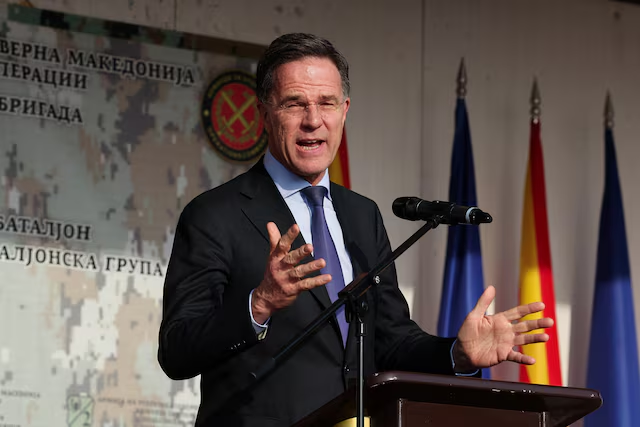
As conflict expands in the Middle East after U.S.–Israel strikes, NATO insists aid to Ukraine in its war with Russia will not stop.
The Iran Crisis That Triggered the Statement
The comments came after a major escalation in the Middle East.
On February 28, 2026, Israel and the United States launched coordinated attacks on Iranian targets. Israel called the operation Operation Roaring Lion, while the U.S. named its campaign Operation Epic Fury.
The strikes targeted Iranian military leaders and key facilities. During the operation, Iran’s Supreme Leader
Ali Khamenei was assassinated.
Washington and Tel Aviv said the goal was to destroy Iran’s nuclear and ballistic missile programs after diplomatic talks collapsed.
Iran’s president,
Masoud Pezeshkian, called the killing a “declaration of open war on Muslims.” He warned that retaliation was Iran’s “legitimate right.”
Iran later launched missile and drone strikes across the region. The attacks hit U.S. bases and infrastructure in several countries, including:
- Bahrain
- Iraq
- Kuwait
- Jordan
- Qatar
- Saudi Arabia
- United Arab Emirates
Early reports suggested more than 1,000 people were killed in Iran, along with casualties in Israel, the United States, and Gulf states.
Did NATO Take Part in the Strikes?
Rutte made it clear that NATO did not directly participate in the attacks.
He told the BBC that the campaign was led by the United States and Israel, not NATO.
However, some NATO members provided support roles, such as logistics and defensive systems. For example, Spain’s Patriot missile system deployed in Turkey provides regional air defense.
Spain strongly criticized the strikes and banned the use of its bases for the operation. The United Kingdom also hesitated to grant base access, which drew criticism from
Donald Trump.
Rutte emphasized that NATO will defend every inch of its territory if necessary.
Why NATO Is Concerned
NATO leaders worry that a long war in the Middle East could distract the United States from the conflict in Ukraine.
In another interview with Germany’s ARD broadcaster, Rutte said NATO must support the U.S. while also ensuring Ukraine remains strong.
Ukraine estimates it will need more than $60 billion in military support in 2026.
Several countries continue to contribute through bilateral aid packages and joint initiatives. Key supporters include:
- Norway
- Canada
- Turkey
The Czech ammunition initiative also remains an important supply channel.
Iran, Russia, and the Wider Security Picture
Rutte has repeatedly warned that several countries are cooperating against Western interests. He has pointed to coordination between:
He said Iran has supported Russia during the Ukraine war by providing drones and missiles.
According to Rutte, weakening Iran’s military capabilities could indirectly help Ukraine.
Global Reactions
International reactions to the strikes have been deeply divided.
António Guterres, head of the United Nations, warned the attacks could threaten global peace. He said diplomacy had been undermined and urged countries to avoid further escalation.
China condemned the killing of Khamenei, calling it a violation of the UN Charter.
Russia described the strike as “an unprovoked act of armed aggression.”
Bottom Line for Ukraine
Rutte’s message was clear: the crisis in Iran will not weaken NATO’s support for Ukraine.
However, maintaining support for two major conflicts at once one in the Middle East and one in Eastern Europe will test the unity and resources of the NATO alliance in 2026.